

Kids
A Weekend Rhythm That Leaves Room to Breathe
A simple weekend rhythm can give your family enough structure to feel grounded without turning Saturday and Sunday into another packed schedule.
A Weekend Rhythm That Leaves Room to Breathe
A completely open weekend can sound wonderful on Friday night. By Saturday morning, though, it can turn into a stream of questions: What are we doing today? Can we go somewhere? I'm bored. What's next?
The answer does not have to be a packed itinerary. In fact, many families do better with something much lighter: a few predictable parts of the day, plenty of room between them, and permission for some hours to be ordinary.
Think of it as a weekend rhythm, not a weekend schedule.
Start with one anchor plan
Choose one thing that gives the day a little shape. It might be a playground trip, library visit, grocery run, soccer game, walk, movie at home, or lunch with grandparents.
One anchor is often enough. It gives everyone something to orient around without making the whole day depend on moving from activity to activity.
The anchor can match your circumstances:
- High-energy day: a bike ride, hike, swimming, or a long playground visit.
- Low-energy day: pancakes and a movie, a board game, or a short walk for a snack.
- Bad-weather day: library, blanket fort, baking, crafts from whatever is already in the house.
- Low-budget day: park, neighborhood walk, picnic from the pantry, free community space, or a family game at home.
If everyone is tired, the anchor can be tiny. “We’ll walk to the corner and get some fresh air after lunch” still counts.
Make room for kids to own some of the day
Children do not need adults to fill every open hour. Independent play, sibling play, reading, drawing, building, listening to music, or simply wandering around deciding what to do can all belong in a normal weekend.
You can make this easier by offering a boundary rather than an entertainment service:
“We’re staying home until lunch. You can play in your room, build something, read, draw, or come help me.”
That gives a child choices without making you responsible for producing the perfect choice.
For younger children, the independent stretch may be short. For older children, it may occupy a large part of the morning. The goal is not a particular number of minutes. It is simply to establish that some weekend time belongs to them to use.
Let boredom exist for a while

“I’m bored” does not always require an immediate solution.
You can acknowledge it without rushing to fix it: “Yeah, it feels like there’s not much happening right now.”
If your child wants ideas, offer a small menu rather than an endless brainstorm. Three options are plenty. You might say, “You could draw, go outside, or help me make lunch.”
If all three are rejected, it is okay to hand the problem back: “Those are my ideas. You might come up with something better.”
There may be complaining before something interesting happens. That does not mean the approach failed. An open stretch of time sometimes feels uncomfortable before it becomes useful.
Include one household contribution
A weekend can also include ordinary family work. Everyone lives in the home, so everyone can have a small part in keeping it going.
This does not need to become a Saturday chore marathon. Pick something concrete and bounded: put away laundry, clear the breakfast table, feed a pet, empty a dishwasher, tidy the entryway, or help prepare lunch.
A small contribution can actually make an unstructured day feel more grounded. There is a clear beginning, a clear end, and a visible result.
Protect actual downtime

Downtime is different from “waiting until the next activity.”
Leave a stretch of the weekend intentionally unclaimed. People can nap, read, play games, watch something, tinker, sit outside, or do very little.
Parents get downtime too. You do not have to spend every quiet hour creating enrichment for someone else.
If screens are part of your family life, they can fit here without needing to carry the entire day. A predictable screen window can sometimes reduce repeated negotiation because everyone knows roughly when it is available and when it ends.
Keep a flexible connection window
Instead of trying to manufacture family togetherness all day, create one easy window when connection is likely.
Maybe everyone has dinner together. Maybe you play cards after lunch. Maybe you take a walk before bedtime or watch one episode of something together.
Keep the expectation modest. Family connection does not have to be a memorable outing. Ten calm minutes over hot chocolate may work better than an ambitious activity that nobody has energy for.
A simple weekend template
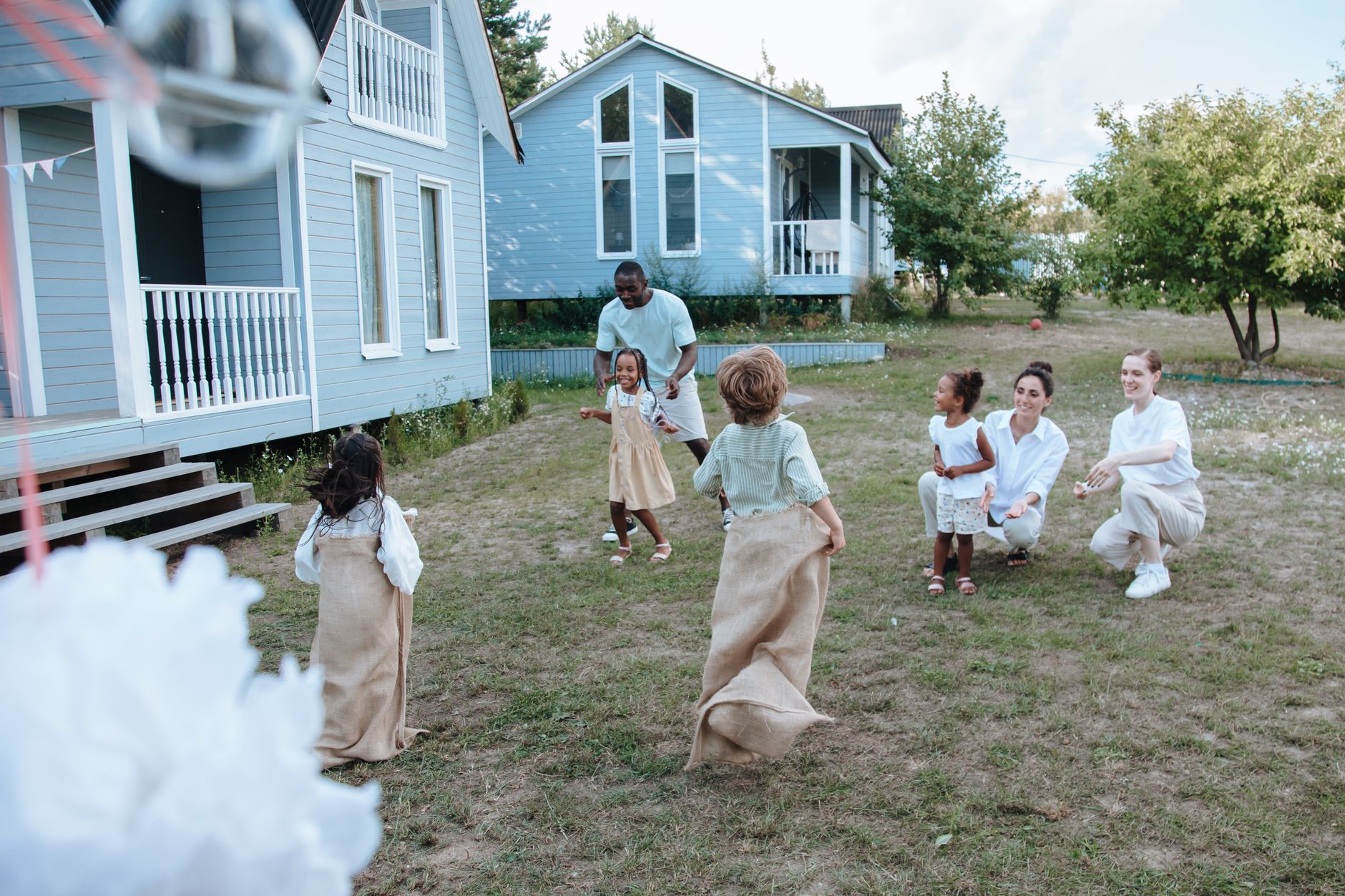
A low-pressure Saturday might look like this:
Morning: slow breakfast, kids play, adults do their own tasks.
Late morning: everyone does one small household job.
Midday: the day's anchor activity.
Afternoon: downtime or independent play.
Late afternoon: flexible family connection—walk, game, snack, or just hanging out.
Evening: dinner and the usual bedtime rhythm.
Nothing here has to happen at an exact time. The sequence is the useful part.
When energy changes, change the plan
Families wake up with different amounts of energy. A rhythm should bend.
If everyone is restless, make the anchor more active. If somebody slept badly, shrink it. If rain cancels your outdoor plan, substitute something simple rather than urgently inventing a full indoor program.
You can also split up. One caregiver and one child might want an outing while someone else needs a quiet afternoon. “Family weekend” does not have to mean everyone doing the same thing every hour.
An open weekend does not need to be optimized
It is easy to look at two free days and feel that you should make the most of them. But rest, ordinary chores, self-directed play, and uneventful family time are also legitimate ways to spend a weekend.
A useful rhythm gives the day enough structure that nobody feels completely adrift, while leaving enough openness that the weekend still feels different from the work and school week.
One anchor. Some play that children own. One contribution to the household. Real downtime. A little family connection.
That can be plenty.