

Kids
A Simple After-Birthday Thank-You Routine Kids Can Actually Help With
A short, age-flexible thank-you routine that helps children practice gratitude after a birthday without turning notes into a major parental project.
A Simple After-Birthday Thank-You Routine Kids Can Actually Help With
After a birthday, the wrapping paper is gone, the new toys have found temporary homes, and there is one last task hovering in the background: saying thank you.
It does not need to become a second birthday project.
A useful thank-you routine can be short, warm, and genuinely shared with your child. The goal is not perfect handwriting, elaborate stationery, or making a young child perform gratitude on command. It is simply to help them notice that someone thought of them and practice responding with appreciation.
Here is a small routine you can repeat after birthdays without turning the week afterward into an administrative marathon.
Start with a very small goal
Instead of thinking, “We need to write all the thank-you cards,” try: “We’re going to spend ten minutes thanking people.”
A short session lowers the pressure for both parent and child. Put the gifts, a quick gift list, or a few names in front of you and choose a manageable number to do. That might be one message for a preschooler or several notes for an older child.
If you finish everything, great. If not, schedule another short session rather than stretching the first one until everyone is frustrated.
The repeatable routine can be as simple as:
- Pick a person.
- Remember what they gave or did.
- Say one specific thank-you.
- Choose how the child will participate.
- Send it or put it in the outgoing pile.
That is enough.
Make gratitude the point, not etiquette
Children can easily experience thank-you notes as a rule imposed by adults: You got a gift, so now you have to write this sentence.
A more meaningful starting point is noticing the other person’s effort.
You might ask:
- “What do you remember about Grandma’s gift?”
- “What are you excited to do with it?”
- “Was there something fun that your friend did at the party?”
- “What would you like them to know?”
A child does not need to produce a polished answer. “I like the dinosaur because it roars” is useful material. So is “I liked when Leo played tag with me.”
That small detail can become the heart of the message.
Match the job to your child’s age and energy

Participation does not have to mean writing a complete card independently.
For a young child, participation might be choosing a crayon, making a drawing, adding stickers, dictating one sentence, or signing their name while a parent writes the rest.
A child who is beginning to write might fill in a simple pattern:
“Thank you for . I like .”
An older child can usually take more ownership, but the task can still stay brief. Two or three sincere sentences are often more manageable than expecting a miniature letter.
For example:
“Thank you for the puzzle. I started it with Dad last night and the animal pieces are my favorite. I’m glad you came to my birthday.”
The format can flex too. Depending on your family and the recipient, gratitude might be expressed with a handwritten note, a drawing, a parent-assisted text, a short voice message, or another simple message. The useful question is not “What is the most impressive thank-you?” but “How can my child meaningfully take part?”
Use the parent as a helper, not a project manager
Parents often end up doing most of the hidden work: finding addresses, remembering who gave what, buying cards, locating stamps, coaching every sentence, and chasing a child around the house for signatures.
Reduce that work wherever you can.
During the party or gift opening, keep a basic list of names and gifts if that is helpful. Afterward, use whatever materials are already easy to reach. Plain paper works. So does a folded drawing. If a digital message is the practical choice, open the message thread and let your child dictate a sentence.
You can also divide the labor deliberately. Your child supplies the personal part; you handle the mechanics they cannot reasonably manage yet.
For example:
Child: “Thank you for my truck. I made a huge road for it.”
Parent: writes or types the words, adds “Love, Sam” if appropriate, and handles the envelope or sending.
The child still contributed the part that matters most.
Try the “three-question” shortcut
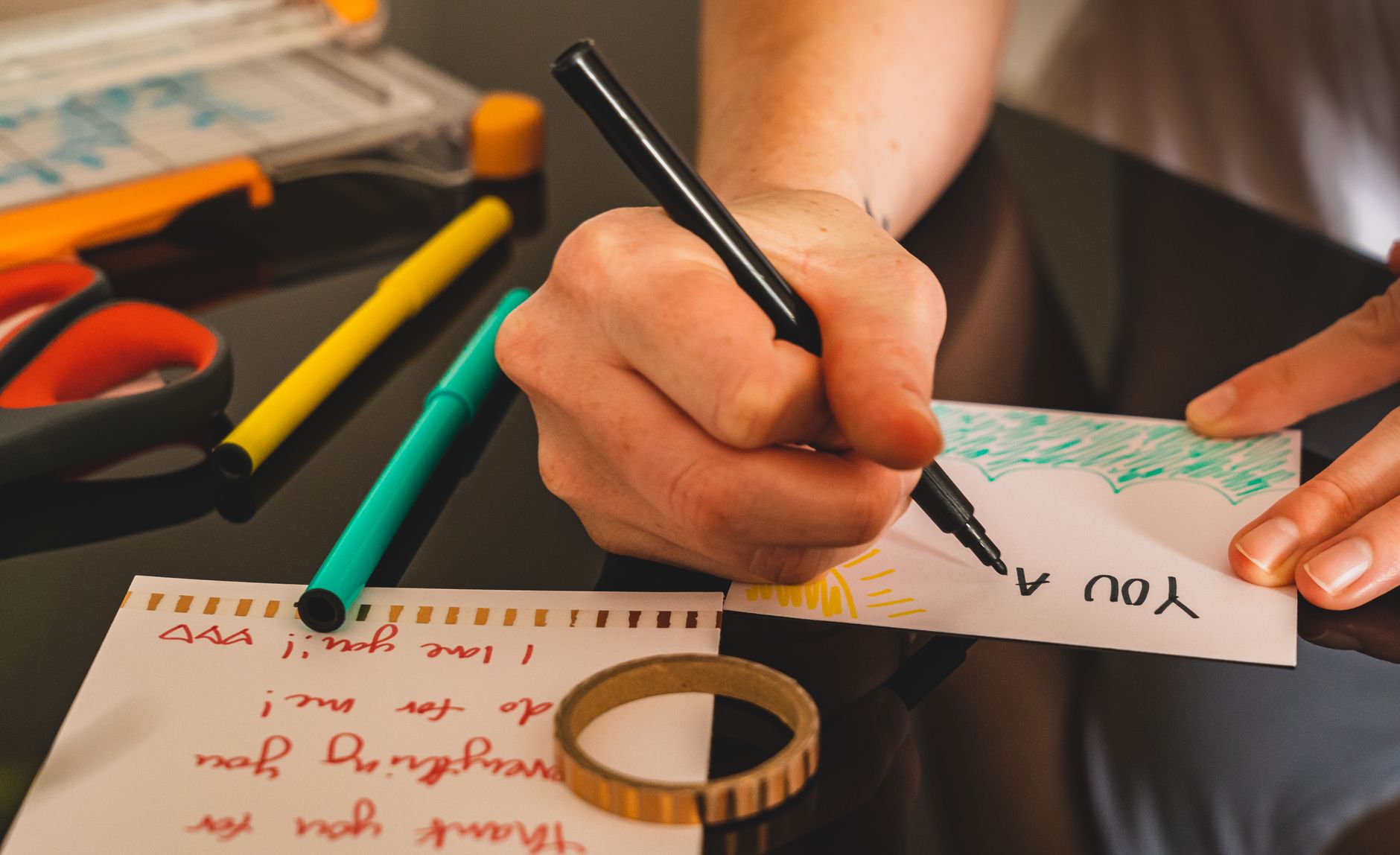
When a child gets stuck, avoid turning the note into an interview. Ask only three quick questions:
Who are we thanking? This keeps the message connected to a real person.
What do you want to thank them for? A gift, their presence at the party, a special activity, or another kindness can all count.
What is one thing you liked, noticed, or plan to do with it? This gives the message a specific detail.
Then stop. You have enough material.
A parent can turn “Aunt Maya, art set, I’m going to paint a dragon” into:
“Thank you for the art set, Aunt Maya! I’m going to paint a dragon with it. I’m happy you celebrated with me.”
No extra creativity is required.
Keep perfection out of it
A backwards letter, uneven drawing, misspelled word, or extremely enthusiastic collection of stickers can make a child’s contribution feel like theirs.
If the message is understandable, resist correcting every detail. When adults optimize the product too aggressively, children can learn that the task belongs to the parent and their own effort is not quite good enough.
You can quietly help where help is needed while preserving the child’s voice.
Likewise, do not worry if every thank-you is not equally original. Repetition is fine. Children are learning a social habit, not competing for an award in correspondence.
Build a finish line

The easiest routine is one with a visible end.
Put completed cards in one spot. Mark names off the gift list. Send digital messages immediately after creating them. When the ten-minute session ends, say, “We thanked three people. We’ll do the last two tomorrow.”
Then be done.
You can even attach the routine to something predictable: ten minutes after breakfast the day after the party, one note before bedtime for three nights, or a short family session on the following weekend.
The exact system matters less than making it small enough that you will actually repeat it.
What if your child does not feel grateful?
Children sometimes dislike a gift, barely know the giver, or simply do not feel enthusiastic at the moment you want to write. You do not have to demand a feeling they are not experiencing.
Gratitude can focus on the gesture rather than pretending to love the object.
A simple message such as “Thank you for thinking of me and coming to my birthday” can be both kind and truthful.
You can model the idea that we can appreciate someone’s care even when a particular present is not our favorite.
A routine worth keeping
Birthday thank-yous can teach something useful when they stay connected to their purpose: another person gave time, attention, or a gift, and we can pause to acknowledge that.
Keep the session short. Give your child a role they can genuinely manage. Help with the mechanics. Accept imperfect drawings and simple sentences. Then finish and move on with your day.
The habit does not need to look formal to be meaningful. A few sincere words, with a child’s real participation, are plenty.