

Kids
Quality Time on Busy Weekdays: Small Ways to Connect With Your Child
Quality time does not have to be long or elaborate. A small, repeatable pocket of full attention can fit into ordinary family life.
Quality Time on Busy Weekdays: Small Ways to Connect With Your Child
When weekdays are packed with work, school, meals, laundry, errands, and bedtime, “quality time” can start to sound like one more thing you are supposed to do well. It does not have to be.
A useful way to think about quality time is a small period of genuine attention that you can actually repeat. Ten calm minutes that happen often may fit family life better than an elaborate activity that requires planning, money, or a free afternoon.
The goal is not to manufacture a perfect family moment. It is simply to create a little space in which your child gets the message: I’m here with you right now.
Start with the life you already have
Before adding anything to the calendar, look for moments that already exist. Connection can happen while dinner is being made, on the walk from the bus stop, during bath time, or in the few minutes before lights-out.
Ask yourself two questions:
- When are we usually in the same place without an urgent deadline?
- What kind of attention does my child seem to enjoy?
A younger child may want you on the floor building or pretending. An older child may prefer talking while doing something side by side. Some children open up on walks; others would rather read, draw, or joke around.
You do not need the objectively “best” activity. You need one that both of you can realistically return to.
Five low-friction ways to connect
Try ten minutes of child-led play
Set aside a short stretch in which your child chooses what to play and you join in. You do not need to improve the game, teach a lesson, or make it productive. Follow their lead.
If ten minutes feels impossible, start with five. The important part is that the time has a clear beginning and that your attention is genuinely there.
Take a short walk
A walk around the block can create an easy side-by-side setting. You can talk, notice things, or simply move together. It does not need to become exercise or a meaningful conversation every time.
Talk while preparing food
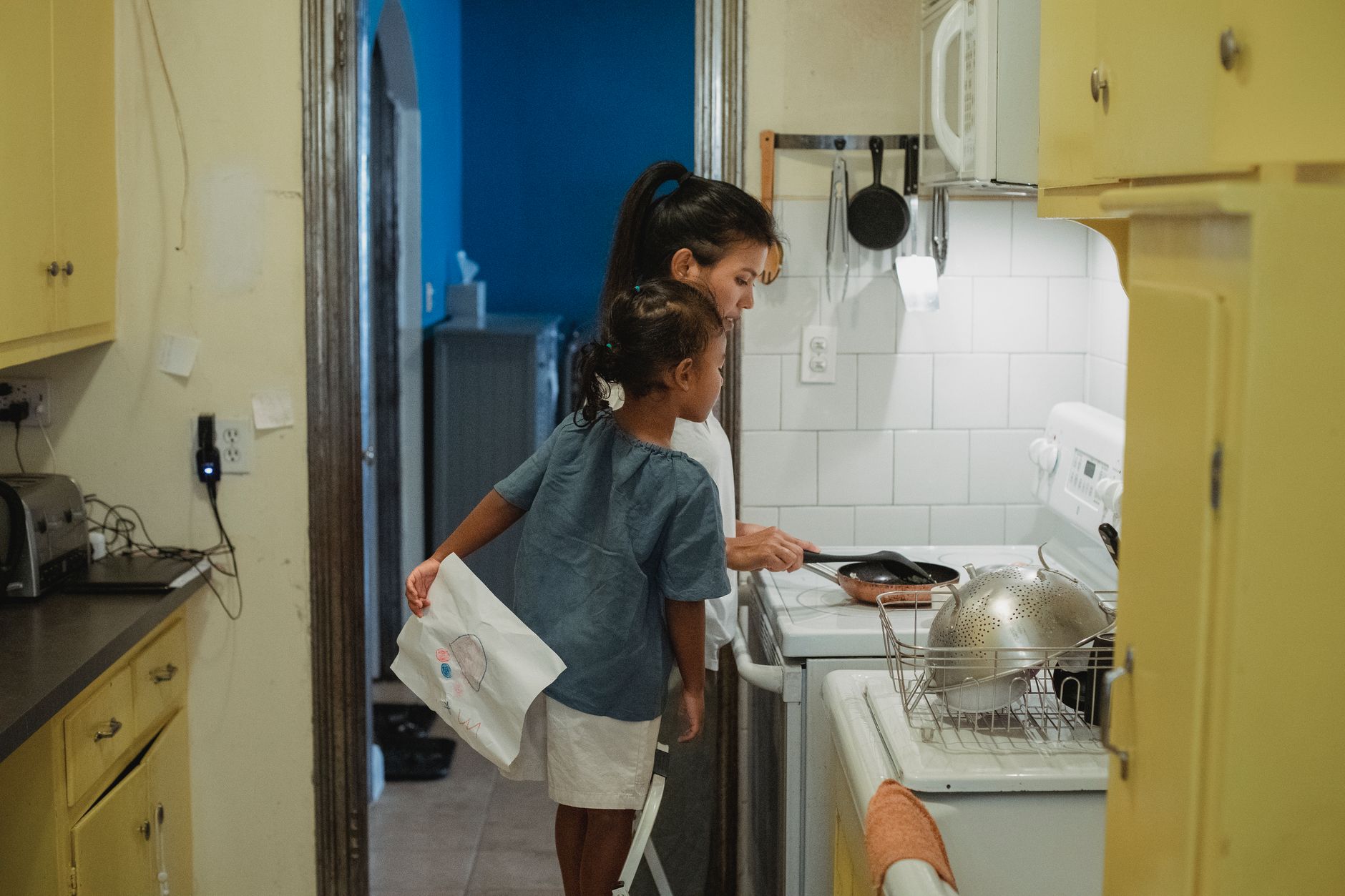
If dinner preparation already has to happen, invite your child into the kitchen. They might wash vegetables, set out plates, sit nearby, or just keep you company. Ask a simple question, tell them something from your own day, or let the conversation wander.
Read something together

Reading can work well because the activity already provides a focus. With younger children, that might mean a picture book. With older children, it could be a comic, a chapter, an interesting article, or even taking turns reading something funny.
Create one tiny ritual
Rituals reduce the need to decide. You might have a “two good things” chat at bedtime, share a snack after school on Tuesdays, play one song together while cleaning up, or make Saturday breakfast a phone-free moment.
Small rituals become useful precisely because they are ordinary.
Protect a pocket of attention
Often the challenge is not finding ten minutes. It is keeping those ten minutes from being swallowed by everything else.
For a short connection window, try making one or two boundaries visible. Put your phone on a counter rather than in your hand. Decide that the dishwasher can wait until the timer ends. If another task pops into your head, write it down instead of immediately doing it.
You can even tell your child what you are doing: “I’ve got ten minutes before I need to start the laundry. For these ten minutes, I’m with you.”
That is more realistic than pretending the rest of life has disappeared.
Match the plan to your child and your family

Different ages and temperaments call for different kinds of connection. A preschooler may happily repeat the same pretend game every day. A school-age child might want a card game or a chance to tell you about an interest. A teenager may be more comfortable talking in the car or while making food than sitting down for a formal conversation.
Family rhythm matters too. If mornings are frantic, do not choose mornings because they sound virtuous. If everyone is exhausted at bedtime, pick another moment.
Choose the easiest useful option, not the most impressive one.
Do not turn connection into a scorecard
There will be days when the plan falls apart. Your child may not feel like talking. You may be tired or distracted. Ten minutes may become three. A carefully protected moment may end in an argument about whose turn it is.
That does not mean the idea failed.
Quality time is not a daily performance review of your parenting. You do not need to track minutes, create special memories on demand, or make every interaction emotionally significant. Ordinary family life includes boredom, interruptions, bad moods, and unfinished chores.
The point of a repeatable ritual is that you get another chance.
A simple experiment for this week
Pick one connection idea and make it small enough to survive a busy day.
For example: “After dinner, before cleanup, we’ll spend ten minutes doing whatever game you choose.” Or: “On the walk home, I’ll keep my phone in my pocket and let the conversation go wherever it goes.”
Try it a few times before deciding whether it works. If it feels forced, change the activity or the timing rather than assuming you need to try harder.
The most sustainable version of quality time is usually not a grand outing. It is a modest, familiar moment in which your child gets a little more of you—and you get a little more of them.