

Kids
Try This Instead of “How Was School?”: A Three-Part Check-In
A simple good-hard-ordinary check-in can make after-school conversation feel less like an interrogation and more like a small family ritual.
Try This Instead of “How Was School?”: A Three-Part Check-In
“How was school?”
“Fine.”
“What did you do?”
“Nothing.”
If this exchange happens regularly in your house, the problem may not be that your child has nothing to say. “How was school?” is simply a very big question. It asks a child to sort through hours of lessons, conversations, transitions, lunch, play, boredom, frustration, and fun—and somehow decide what counts as an answer.
A smaller question can be easier.
One simple option is a three-part check-in: one good moment, one hard or awkward moment, and one ordinary or boring moment.
It is not a method for extracting information. It is just a conversational structure you can offer.
Why specific prompts can feel easier
Compare these two questions:
“How was your whole day?”
“What was one boring part?”
The second question gives the brain a much smaller search area. It also signals that a day does not have to be summarized as either “good” or “bad.”
A child might say:
“Math was boring.”
“Liam made me laugh at lunch.”
“I couldn’t find my hat.”
“We had pasta.”
Those tiny details often make better conversation starters than a demand for a full report.
And sometimes the answer will still be, “I don’t know.” That is okay too.
Try good, hard, ordinary
Your three categories can be:
A good moment: Something nice, funny, interesting, satisfying, or comfortable.
A hard or awkward moment: Something annoying, confusing, disappointing, embarrassing, frustrating, or simply difficult.
An ordinary or boring moment: Something that was neither wonderful nor terrible. Lunch. Waiting in line. Putting away pencils. Walking to class.
The third category matters because most days contain a lot of ordinary life. It lowers the pressure to produce a dramatic story.
Go first
If you introduce the ritual by questioning your child, it can still feel like an interrogation.
Instead, model it.
At dinner you might say:
“My good moment was finishing something I’d been putting off. My awkward moment was realizing I had forgotten to reply to someone. My boring moment was unloading the dishwasher.”
Then stop.
You can ask, “Want to do yours?” But you do not need to immediately fire three questions at them.
Going first shows what kind of answer you mean. It also makes the exchange reciprocal: family members are sharing bits of their days, rather than adults interviewing children.
Keep it short
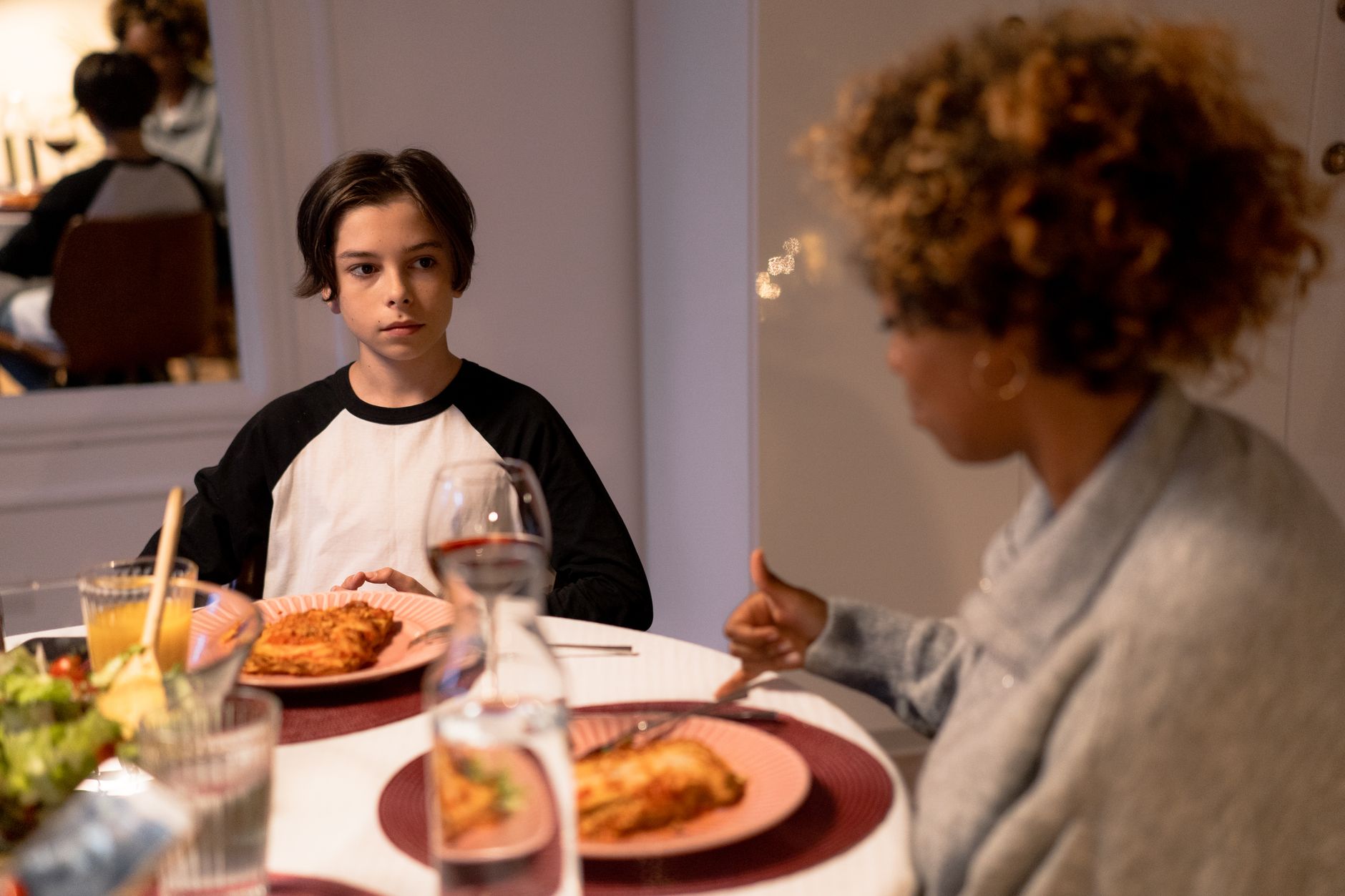
The ritual works best when it is small enough that nobody dreads it.
A child does not need to explain why the good moment was good. They do not need to name everyone involved in the hard moment. They do not need to give you enough information to reconstruct their day.
If they say:
“Good: recess. Hard: spelling. Boring: lunch.”
That can be the entire check-in.
You can respond naturally—“Sounds like spelling was rough today”—without turning every answer into a follow-up investigation.
If they want to say more, there is room.
Make it optional
A check-in should be an invitation, not a daily disclosure requirement.
Useful responses include:
- “You can pass on any category.”
- “Want to do one instead of all three?”
- “No problem. Maybe later.”
- “You don’t have to tell me.”
A child may have a perfectly good reason not to discuss something immediately. They may be tired, still processing it, eager to play, or simply not in the mood.
Respecting a “pass” helps keep the ritual conversational.
Match the ritual to the moment
There is no universally perfect time for children to talk. Experiment.
At pickup

Some children talk easily in the car or while walking home because nobody is sitting face-to-face waiting for an answer.
Keep it especially light after school:
“Want to give me one good, hard, or boring thing—or just decompress?”
A snack and ten minutes of quiet may be more useful than questions.
At dinner
The ritual can become a family round where everyone participates.
One person shares a good moment, then everyone else does. Or each person gives all three.
Adults should participate too.
At bedtime
Bedtime can work well for children who become more conversational when the day is quiet.
You might ask, “Anything from today you want to put in the good, hard, or ordinary bucket before we say goodnight?”
If the answer opens a larger concern, listen—but do not make bedtime the only place your child can bring up difficult things.
Change the categories when they get stale

A ritual stops feeling natural if it becomes a script everyone recites mechanically.
Try variations:
- funny / frustrating / forgettable
- something you learned / something you noticed / something you’d change
- kind moment / tricky moment / regular moment
- best snack / weirdest thing / most boring thing
- something that gave you energy / something that used up energy
You can also let your child invent the categories.
The structure is there to make conversation easier, not to create another family obligation.
Listen more than you investigate
Suppose your child says, “The hard part was recess.”
It can be tempting to immediately ask:
“What happened?”
“Who was there?”
“Did someone do something?”
“Did you tell the teacher?”
Sometimes those questions are necessary. But often the best first response is smaller:
“Recess was hard today.”
Then wait.
Your child may explain. They may change the subject. They may tell you tomorrow.
If something they share suggests they need adult help, you can of course respond appropriately. But ordinary check-ins do not need to function as detective interviews.
Let mundane answers count
One quiet benefit of asking about ordinary moments is that it teaches everyone in the family that everyday details are worth sharing.
“The bus was late.”
“We sharpened pencils.”
“My friend had crackers.”
“I wore my blue sweatshirt.”
Connection is often built from exactly this kind of small information. You are learning the texture of one another’s lives, not collecting a daily performance review.
The ritual is a doorway, not a report
A three-part check-in cannot guarantee that your child will tell you everything important, and that should not be the standard.
Its job is much simpler: create a predictable, low-pressure opening for conversation.
Some days you may get a whole story. Some days you may get three words. Some days your child may pass.
You can still communicate the thing that matters most: “I’m interested in your world, and you can talk to me without having to produce a perfect account of your day.”